The three main reasons why people don’t get the results they want from their business are:
Lack of focus on one idea.
Lack of focus on the ideal customer.
The size of the action they take is too small.
Marketing is what you do to put your product/service in front of potential customers. Sales is what you do to close the deal and get the piece of work.
Marketing brings people into your shop/cafe. Sales get them to buy a cake with their coffee whilst they are there.
Marketing brings traffic to your website. Sales closes the deal and helps them to make a buying decision.
We think about our sales and marketing as a funnel. Your marketing efforts pour people into the top of your funnel and eventually sales drop out of the bottom! The funnel is a numbers game and it shows the steps your potential customers will take on their way to an order:
- Interrupt your potential customers day
- Learn about what you’re selling and
- Make a decision about whether they want to buy
At the top of the funnel are the handful of methods you’re going to choose to promote your business, the middle of the funnel is about once you’ve got them hooked in, what more information do they need to make a decision, and at the bottom is the close.
To bring this to life, let us run through how we sell Rebel Business School courses and what our marketing funnel looks like.
Below is an image showing our funnel:
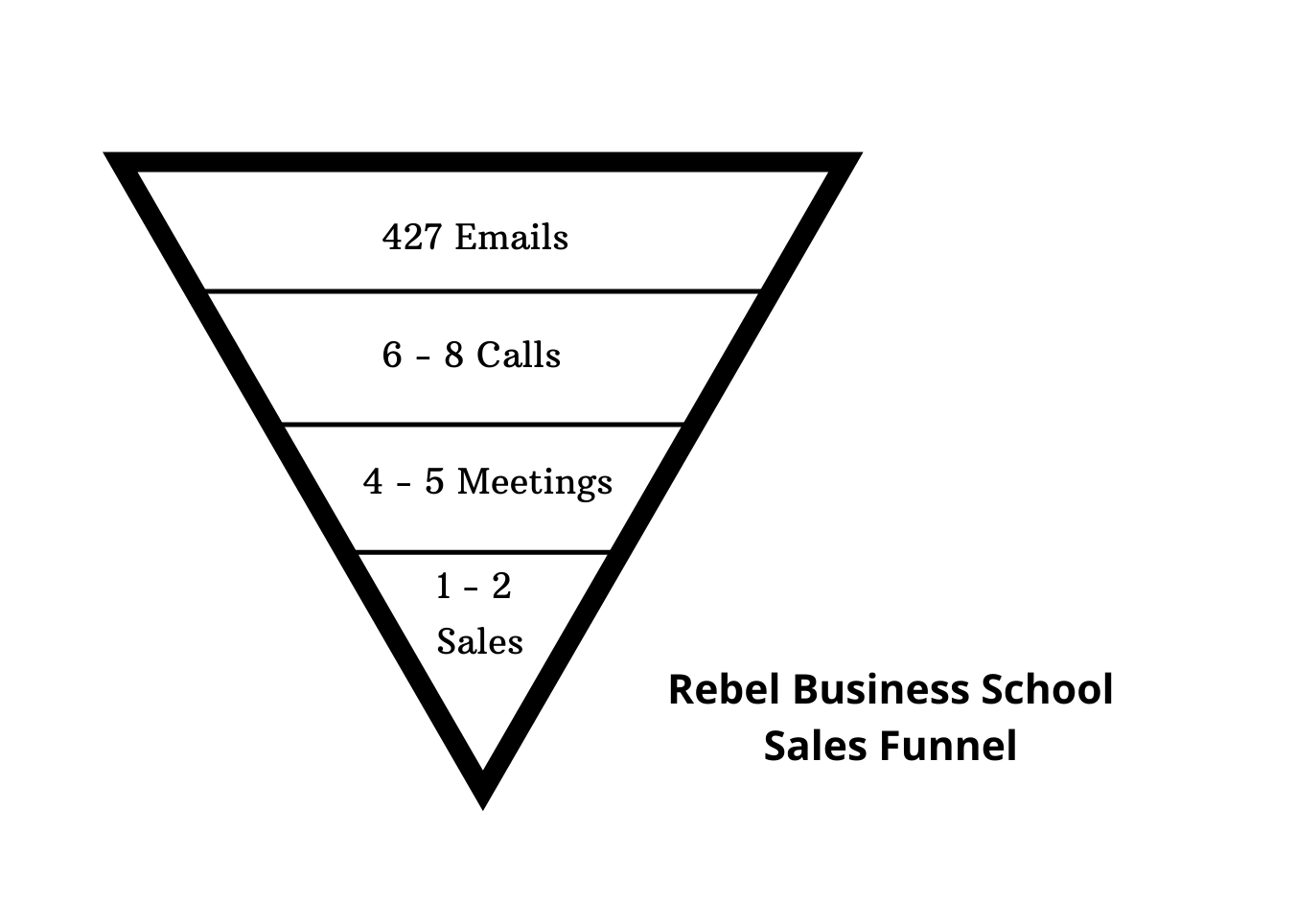
How we sell Rebel.
We have three primary methods we use to market Rebel Business School; social media like LinkedIn and Twitter, direct emails and sending Alan and Simon to speak at conferences. The more we do of these activities the more people we engage with and the more potential business leads we find.
For example, if we send 427 emails to CEOs of housing associations what do you think happens?
We get 30 instant out-of-office replies, we get a few “don’t email me ever again” replies (this really hurt the first time it happened) and we get a few “this is interesting give me a call” replies. This normally leads to 6- 8 calls with interested people. If the call goes really well then this normally leads to 4 – 5 meetings at their offices. If the meeting goes really well it leads to us sending them a proposal and possible business coming out the other end!
So 427 emails lead to 1–2 possible deals. Can you see the size of the action we have to take to get business? The more effort we put in at the top of the funnel, the better chance we have got at winning business and the more people we can help.
Here’s what we want you to take away from this:
1. Focus on the customer
Here is one thing we know: If you try and sell to everybody, you’ll end up selling to nobody.
How do you describe the customer who is MOST LIKELY to buy your product or service? You need to know very, very clearly exactly who you are targeting. The clearer you are the easier it is to choose the best marketing methods to fill your funnel.
2. Choosing the marketing methods to use
Once you’re clear on who your target customer is, you then need to explore these questions:
- Where do my customers go? Online and in real life (or #IRL as the kids say).
- What is the best method to reach them?
- How can I do it in a way there’ll be most receptive?
This will help you make some choices about the best marketing tools you can use to reach your customers.
There is one single answer to every question you’ll ever ask about marketing:
Which social media platform should I use?
Who’s your customer?
Should I email people?
Who’s your customer?
Should I print flyers?
Who’s your customer?
Exploring your marketing decisions in this way will help you make your decisions. Then you can decide on the marketing methods that you will use to fill your funnel. We’ve worked with companies like British Airways and Sainsbury’s who have invested MILLIONS in knowing their customers, and ensuring their businesses remain customer-centric – why would they do that?
3. The size of the action
When we first started Rebel, we sent thirty-five letters. It led to three phone calls, two meetings and one sale (we were lucky). We should’ve sent 500. If we send out 500 emails to our potential customers, here’s what happens:
- 6-8 not for me
- 6-8 not now
- 20-25 auto-response
- 2 or 3 take me off your list
- 6-8 interesting; tell me more
Out of the “interesting, tell me more” phone calls, we’ll get 4-5 face-to-face meetings and secure 3-4 sales.
In the early days we can be paralysed by fear of failure and only send one or two emails, then get depressed when there’s no reply.
Don’t send five emails, send FIVE HUNDRED.
Don’t make one call, make ONE HUNDRED.
Don’t send ten tweets, send ONE THOUSAND!
If you’re not filling your funnel, you’re not filling your pockets. If only we had realised this at the start of Rebel we would have got so much further, so much faster. It is all about the size of the action you take.
In a nutshell:
- Decide on your target customers.
- Work out the range of marketing tools you are going to use to reach them. (Twitter, Facebook, phone etc.)
- TAKE MASSIVE ACTION: contact all of them, make it happen and get out there.
- Work through the funnel and the steps you have to take to get to a sale.

